
Reviewed · SELF-GUIDED TOURS
Glasgow Private Self-Guided Tour
Glasgow has a lot hiding in plain sight. This self-guided route stitches together medieval monuments, big 19th-century planning, and street art you can spot from blocks away. You follow a mapped GPS path with an audio guide by Alex, then finish near St Enoch Subway Station.
Two things I really like are the smart mix of stops, and the way the audio connects each place to the next. The walk is also short enough to fit in even if your day gets busy, since it’s listed at about 2 to 3 hours.
One consideration is that the tour is app-based, so your phone battery matters. If your audio volume is low or your device struggles with navigation, you may feel a bit rushed instead of in control of your pace.
In This Review
- Key highlights at a glance
- How the self-guided audio tour works, with Alex on your phone
- The app experience: worth planning for
- Glasgow Cathedral and the Necropolis: a strong start in old stone
- Next stop: the Necropolis’s “serious size”
- Practical tip for the Necropolis
- Provand’s Lordship, and why Glasgow murals change how you see walls
- Then the route leans into murals on purpose
- University of Strathclyde and the Smug mural moment at St Enoch
- Smug’s futuristic St Enoch mural
- Tron Theatre tower, police history, and the Mercury statue in Merchant City
- Smug’s Fellow Residents mural and a clever detail
- 98 Ingram Street: gothic revival and the tobacco merchants
- Mercury: commerce, boundaries, and a statue with attitude
- City Chambers, George Square, and the tea room stop that ties it all to design
- George Square’s Georgian grid planning
- A design-focused 1983 establishment and tea room history
- Buchanan Street, The Lighthouse, and the final Smug mural at St Enoch
- Final mural: Honey, I shrunk the Kids
- Price and value for a 2 to 3 hour self-guided walk
- Who should book this, and who should skip it
- Should you book this Glasgow Private Self-Guided Tour?
- FAQ
- How long is the Glasgow Private Self-Guided Tour?
- How much does it cost per person?
- Where do I start and where does it end?
- Do I need a live guide?
- What language is the audio guide in?
- Is there a museum or attraction entrance fee included?
- What do I get with the included access?
- Is it private for my group only?
- Is it refundable?
- Are service animals allowed?
Key highlights at a glance
- Alex’s audio guide in English keeps you moving between major landmarks and small details.
- Glasgow Cathedral and the Necropolis give you two powerful “this city has old roots” bookends early on.
- Street art stops by Smug turn murals into a real walking theme, not just photo stops.
- Merchant City moments include the Mercury statue and 98 Ingram Street for a good shift from sacred to civic.
- A short ending loop around Buchanan Street, The Lighthouse, and the final mural near St Enoch ties the whole route together.
How the self-guided audio tour works, with Alex on your phone
This is a private self-guided experience, meaning it’s set up for only your group. There’s no live guide traveling with you, so you’re relying on the app, the GPS directions, and the audio narration.
After you book, you get an email with instructions to activate your tour (your booking reference is not the code). You also need to download the Pandemic Tours app once your booking is confirmed, and then the tour gives you 3 weeks of unlimited access.
The audio guide is a real narration, not a computer-generated voice. Expect Alex to talk as you walk, and use the on-screen map and routed stops to keep yourself oriented.
More routes taken at your own tread:
- Glasgow Ghost Hunt: The Soul That Got Away Exploration Game★ 4.0 · 71 reviews
- The Ghost of Mary Queen of Scots Escape Room★ 5.0 · 24 reviews
- Magicians Heist Private Escape Room in Glasgow★ 5.0 · 23 reviews
- Fun and Flexible Treasure Hunt Around Glasgow with Cryptic Clues★ 5.0 · 9 reviews
The app experience: worth planning for
The strongest version of this tour is when you let the audio run and only check the map when you need to confirm your bearings. If your app or phone is slow, you can end up doing extra taps or re-opening the guide, which turns a relaxed walk into a mildly annoying tech errand.
My practical tip: come with headphones you trust, and set your volume before you start. If you notice the audio is quiet, fix it immediately, not after you’ve already walked a few blocks.
Glasgow Cathedral and the Necropolis: a strong start in old stone
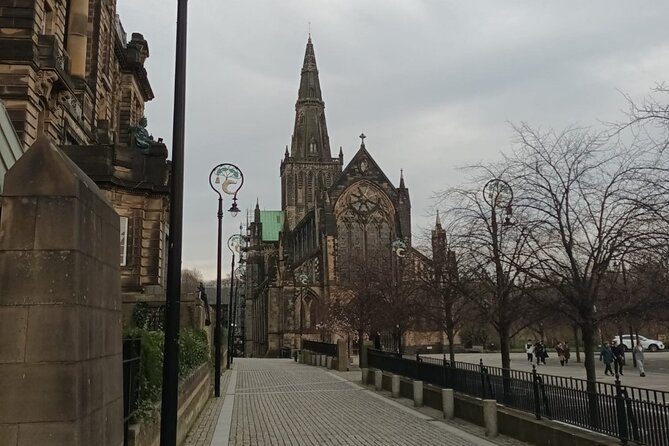
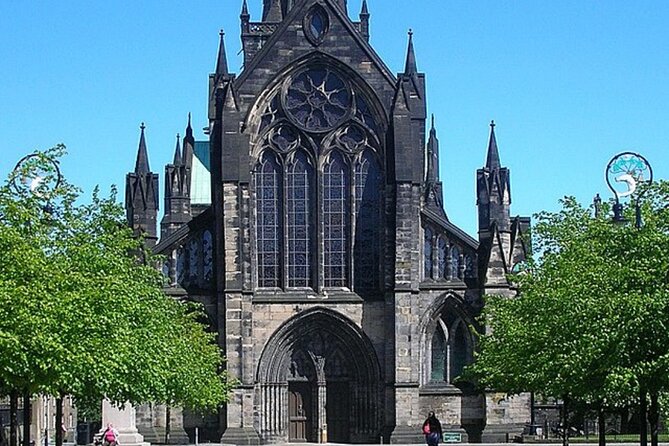
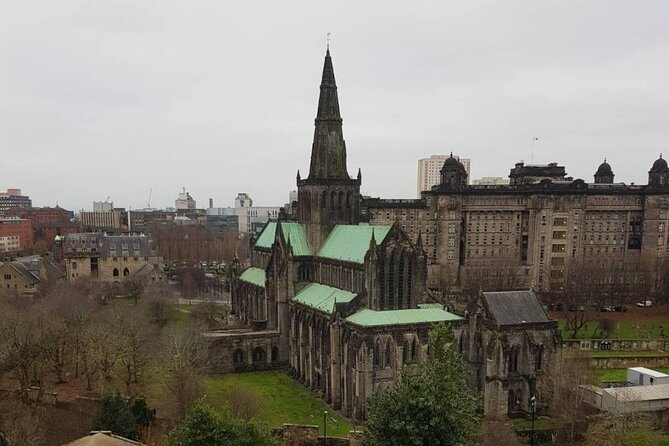
Your route starts at Glasgow Cathedral on Castle Street, right at the beginning of Scotland’s long architectural story. This cathedral version is dated to 1197, built after an earlier cathedral from 1136 suffered a fire. The impressive part is that worship continued inside for more than 800 years, and the building never went back to being fully roofless.
The stop is timed at about 30 minutes, which is just right if you want a meaningful look without turning this into a half-day church project. You’ll also hear how the cathedral sits with its surroundings, and why it’s still one of Glasgow’s emblems.
Next stop: the Necropolis’s “serious size”
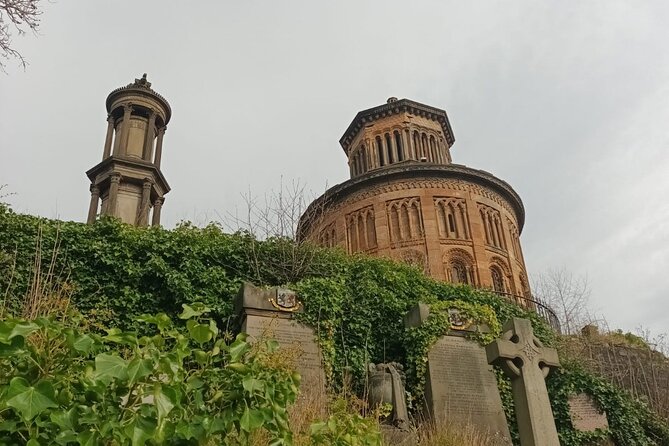
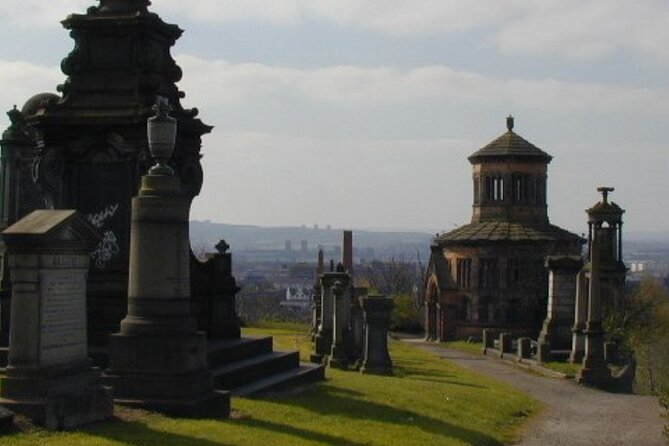
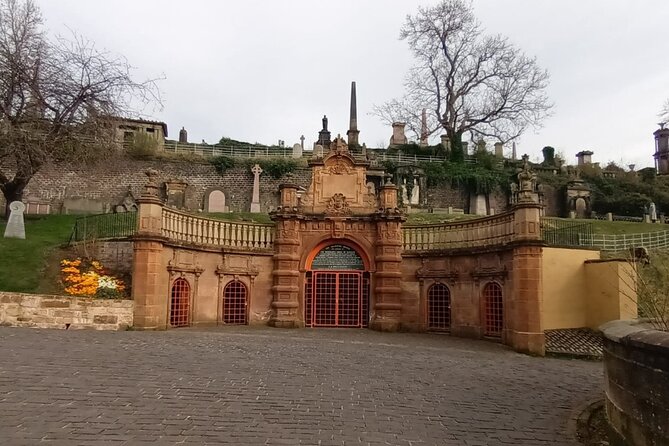
From there you head to the Glasgow Necropolis, Glasgow’s most famous graveyard. It was established in 1831, modeled after the Parisian Père Lachaise. The idea at the time was simple but ambitious: wealthy residents wanted to show their status even after death.
This Necropolis spreads over 37 acres, roughly equal to about 15 soccer fields, or around 150,000 square meters. The visit is listed at about 15 minutes, and I’d stick close to that unless you’re the type who likes to read names and symbols for a while.
What Glasgow keeps behind the bar
- Guided Celtic Park Stadium Tour
★ 5.0 · 3,136 reviews - Tennent’s Brewery Tours Ticket
★ 5.0 · 1,938 reviews - City Sightseeing Glasgow Hop-On Hop-Off Bus Tour
★ 4.5 · 1,873 reviews - Oban, Glencoe, Highlands Lochs & Castles Small Group Day Tour from Glasgow
★ 5.0 · 1,432 reviews
Practical tip for the Necropolis
Graveyards can be windy and exposed, even on mild days. If you want good photos, pick a spot slightly off the busiest path so you can frame monuments without too many passersby.
Provand’s Lordship, and why Glasgow murals change how you see walls
Midway through the walk, you’ll reach a stone building called Provand’s Lordship. It was known in later centuries by that nickname, but before it was Provand’s Lordship, it was the Hospital of St Nicholas. The first official record shows up in 1626, and the building has worn different roles over time, from town clerk’s office to justice court to town council, and even a jail at the top for security reasons.
This is one of those stops that works even if you only spend a few minutes, because the audio gives you the timeline. Instead of treating the building as a static photo backdrop, you get a sense of how the same structure served the city’s changing needs.
Then the route leans into murals on purpose
Glasgow is famous for murals, and your audio route treats them like a theme, not random street decor. The murals you’ll be told about were created to revitalize neglected walls and gable ends, and to shift how people view street art.
This matters because it changes your walking mindset. You stop scanning just for big landmarks and start noticing details like style, subject, and how murals “talk” with the architecture next to them.
University of Strathclyde and the Smug mural moment at St Enoch
You move on to the University of Strathclyde, listed as one of Glasgow’s three major universities. Even if you’re not a campus person, this stop is useful because it combines murals with interesting architecture, and it helps you see Glasgow as a living city rather than a museum.
That stop is timed at about 15 minutes. It’s enough time to check the building features the audio points out, then get back to walking before your day turns into one long pause.
Smug’s futuristic St Enoch mural
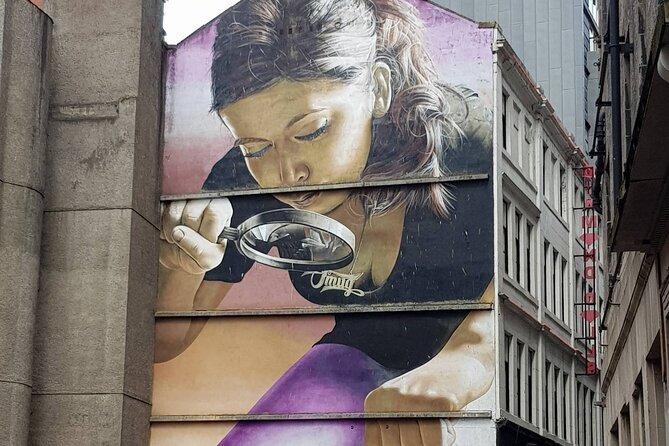
Next comes a short mural stop called St Enoch cradling St Mungo Mural. It shows a mother lovingly cradling a baby, but the depiction is also described as a futuristic representation of St. Mungo. The stop is brief, about 5 minutes, so treat it as a quick “look close, then move” moment.
If murals are your thing, this is a great point in the route to slow down for just a minute and zoom in on small details. The audio approach is geared toward that exact habit.
Tron Theatre tower, police history, and the Mercury statue in Merchant City
This part of the walk shifts from sacred spaces and street art into city life, civic power, and money symbolism. You’ll see the tower of Tron Church, which today is Tron Theatre. The street where it sits is called Trongate, and the name connects to older local storytelling, including a reference to Saint Thenew’s Gait and the supposed site of Thenew’s burial.
Then the route takes you to the museum focused on policing. Glasgow had the first police force in Great Britain, and the museum tells that story from 1800 to 1975. For many people, that’s a surprising fact, and it gives you a way to see the city’s order-making, not just its buildings.
Smug’s Fellow Residents mural and a clever detail
You’ll also hit a mural called Fellow Residents of Glasgow, painted by Smug. The image shows a hiker foraging for mushrooms in woodland, and it looks like a fairy-tale scene. One standout detail described in the tour is that the animals appear through what look like holes in the wall.
This kind of mural design rewards eye contact. It’s not just “street art exists,” it’s “street art is hiding a second story inside the wall texture.”
98 Ingram Street: gothic revival and the tobacco merchants
Next is 98 Ingram Street, a church originally built in 1824 to replace an older version. It was designed by English architect Thomas Rickman in the gothic revival style.
On the graveyard side, you’ll find graves of tobacco merchants Andrew Buchanan and John Glassford. The audio also contrasts burial “fashion,” since the older Ramshorn cemetery, partly covered by Ingram Street now, was described as the expensive fashionable place in the 18th century before the Necropolis became the new destination for burials.
This stop is timed at about 5 minutes, so you’ll want to focus on whatever the audio flags first. The names and style make it feel personal, even in a short time window.
Mercury: commerce, boundaries, and a statue with attitude
The next quick stop is a statue of Mercury, the Roman god associated with financial gain, commerce, eloquence, poetry, travelers, boundaries, luck, trickery, and thieves. Mercury stands on a marble plinth, and this statue is one of two made by Alexander Sandy Stoddart. The statues represent the Italian quarter of Merchant City.
That’s a fun Glasgow moment because it’s simultaneously classical and cheeky. If you like symbolism, this is a stop you’ll appreciate because the audio gives you the reason it’s there.
City Chambers, George Square, and the tea room stop that ties it all to design
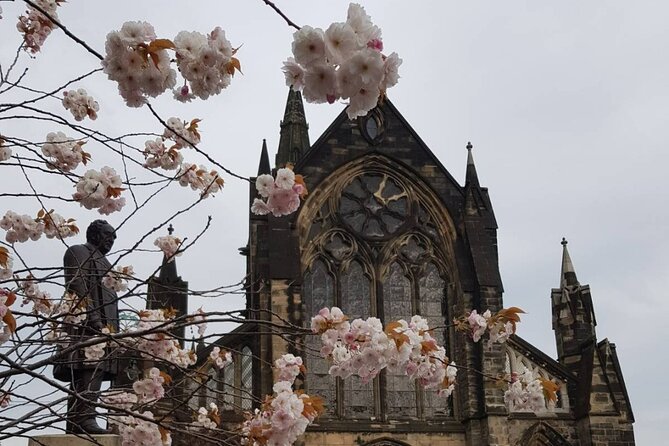
The walk continues to the City Chambers area, with the City Chambers completed in 1888 and inaugurated by Queen Victoria. Queen Victoria is honored with a statue at the opposite end of George Square, which the audio points out in context.
There’s also a mention that the City Chambers were used as a registry office in a famous series. The tour invites you to guess which one, which is a playful touch, but you can also just treat it as an extra reason to look up from the pavement and notice the setting.
George Square’s Georgian grid planning
George Square is named after King George III and was initially laid out as early as 1781 as part of a grid-style plan for the Georgian city center. Development took another 20 years, which makes the square feel like a real artifact of long-term city planning rather than a random open space.
After that, you’ll pass an emblem of Glasgow that might feel bizarre at first, and the audio explains the story behind it and the city’s sense of humor. You also reach a must-visit gallery stop where the audio tells you what you should know.
A design-focused 1983 establishment and tea room history
The tour also includes an establishment from 1983 tied to Charles Rennie Mackintosh. The audio says the interior draws inspiration from his works, and that the tea room itself is modeled on Kate Cranston’s Ingram Street tea rooms from the early 1900s.
If you want a break during the 2 to 3 hours, this is one of the better spots to consider it, because it’s both a pause and a design-focused stop.
Buchanan Street, The Lighthouse, and the final Smug mural at St Enoch
Now you shift into Glasgow’s more modern center. Buchanan Street is the listed stop that marks the jump from older centuries into today’s lively shopping core.
Then you’ll see The Lighthouse, described as a visitor centre, exhibition space, and event venue in the heart of Glasgow. It’s a useful pause point if you want indoor options later, and it also gives you a “city hub” feeling before the walk ends.
Final mural: Honey, I shrunk the Kids
One last mural ends the route, called Honey, I shrunk the Kids. It’s referred to as photo-realistic street art. The stop is quick, and the audio uses it like a finish line for the overall theme: street art you can track as a line through the city.
The tour wraps near St Enoch subway station, described as close to the Roman Fort. The audio frames the ending as a full-circle point, so the last stretch feels like closure rather than just “walk until you’re done.”
Price and value for a 2 to 3 hour self-guided walk
At $12.37 per person for a private self-guided experience, this is priced like a low-cost way to get structure. The key value isn’t just that you’re paying for a route, it’s that the audio guide connects major landmarks, smaller historic buildings, and mural stops into a coherent walk.
You also get 3 weeks unlimited access to the tour in the app. That matters if you want to re-listen while you’re wandering, or if your first run is cut short by weather or a late start.
Where the value can drop is if your phone audio and navigation are finicky. A clunky app experience or quiet audio can make the tour feel like extra work. So I’d treat headphones as part of the cost, even if they aren’t listed.
Who should book this, and who should skip it
I think this is a strong fit if you like history but don’t want to be trapped inside one type of place. It works well for people who enjoy a “walk with a theme,” where the theme is Glasgow’s timeline plus its street art culture.
It also suits solo travelers who want control of pace. You can take a few extra minutes at the cathedral, skim the Necropolis quickly, then spend more time on murals if that’s where your brain wants to go.
I’d skip this if you need a live person to answer questions, or if you dislike app-based navigation. And if audio quality is a big deal for you, bring your own hearing setup and check volume right away.
Should you book this Glasgow Private Self-Guided Tour?
If you want a short, well-shaped introduction to Glasgow that mixes architecture, cemeteries, civic sites, and street art, this is an easy yes. The route is short enough to stay flexible, and the audio by Alex gives you context without demanding museum ticket time.
Book it if you’re comfortable walking a few neighborhoods in one go and using a phone for navigation. Skip it if you know you hate app logistics or if your device often struggles with audio playback outdoors. For most people, it’s a smart way to see more of Glasgow while staying in control of your own pace.
FAQ
How long is the Glasgow Private Self-Guided Tour?
The tour is listed at about 2 to 3 hours.
How much does it cost per person?
It costs $12.37 per person.
Where do I start and where does it end?
You start at Glasgow Cathedral, Castle St, Glasgow G4 0QZ. You end near St Enoch Subway Station, Glasgow G1 4BW.
Do I need a live guide?
No. This is a self-guided tour, and Alex provides the audio guidance through the app.
What language is the audio guide in?
The experience is offered in English.
Is there a museum or attraction entrance fee included?
The tour notes that any entrance fee for attractions mentioned during the tour is not included. Some stops are marked as admission ticket free, but keep an eye out for anything that might cost.
What do I get with the included access?
You get 3 weeks of unlimited access to the self-guided tour on the app, plus a map, directions, GPS route, audio guide, videos, pictures, and recommendations.
Is it private for my group only?
Yes. It’s listed as a private tour/activity, so only your group will participate.
Is it refundable?
No. This experience is non-refundable and cannot be changed for any reason.
Are service animals allowed?
Yes. Service animals are allowed, and the tour is near public transportation with most travelers able to participate.
The newest pours out of Glasgow





Self-Guided Tours, compared.

The Anatomist – Award Winning Historical Escape Room Experience
Read our review →
Glasgow Ghost Hunt: The Soul That Got Away Exploration Game
Read our review →
Fun, Flexible Treasure Hunt Around Edinburgh with Cryptic Clues & Hidden Gems
Read our review →
Harry Potter’s Edinburgh: A Self-Guided Audio Tour
Read our review →

Paisley History Walking Tour with Personal Audio
Read our review →Browse the lists this tour appears in