
Reviewed · HISTORICAL TOURS
The Magnificent and Mysterious History of Glasgow
Glasgow history hits the street fast. This Glasgow walking tour is a smart way to get your bearings and learn how Merchant City grew into the place you see today. I like that it packs famous landmarks and local oddities together, from City Chambers and the bust of Robert Burns to the oldest parts of Glasgow at the cathedral and beyond. You also get enough story to understand why Glaswegians talk the way they do about class, religion, and civic pride.
The one thing to keep in mind is that it is still a walking tour with lots of short stops. Some buildings can be affected by access limits, private services, or short-term construction, and if you are sensitive to noise, a full group can make it harder to hear at times.
In This Review
- Key Highlights You Will Actually Feel
- Getting Your Bearings Around Merchant City in One Go
- George Square Start: City Chambers, War Memorial, and the Pride Machine
- Statue-Hop to Trade Power: Merchant’s House and the City’s Money Stories
- A Georgian Townhouse and the Busy Middle of the City
- Trades Hall, Candle Makers Street, and the Crafts That Built Glasgow
- Corinthian Club and the Way Buildings Keep Changing Jobs
- Saints of Ingram and Hutchie’s Hospital Theme
- From Old Fruitmarket to Trongate 103: Commercial Glasgow to Creative Glasgow
- Britannia Panopticon Music Hall and the Stan Laurel Connection
- Mercat Cross, High Street Murals, and Religious Glasgow’s Symbols
- Royal Infirmary Museum Area and Ramshorn Theatre
- Glasgow Cathedral to Provand’s Lordship: Ending in Oldest Glasgow Layers
- Price, Group Size, and Why $17.91 Feels Like Real Value
- What Can Go Wrong, and How to Prepare
- Who Should Book This Glasgow Tour?
- Should You Book It?
- FAQ
- How long is the Glasgow walking tour?
- Where does the tour start and where does it end?
- What languages is the tour offered in?
- Is the ticket mobile, and do I need any printout?
- How big is the group?
- Do I need good weather for this tour?
Key Highlights You Will Actually Feel
- A tight route that links major squares, murals, and old churches without feeling like a long trek
- Big civic landmarks first, starting at City Chambers and moving through George Square statues
- Merchant City details you would miss alone, like historic trade buildings and street legends
- Art stops that explain why Glasgow became a creative city, including the Gallery of Modern Art and Trongate 103
- A fun, story-driven guide style, with guides like Henry Bell and Bruce known for clear explanations and humor
- A classic finish in historic layers, Glasgow Cathedral, Provand’s Lordship, and the St Mungo Museum area
Getting Your Bearings Around Merchant City in One Go
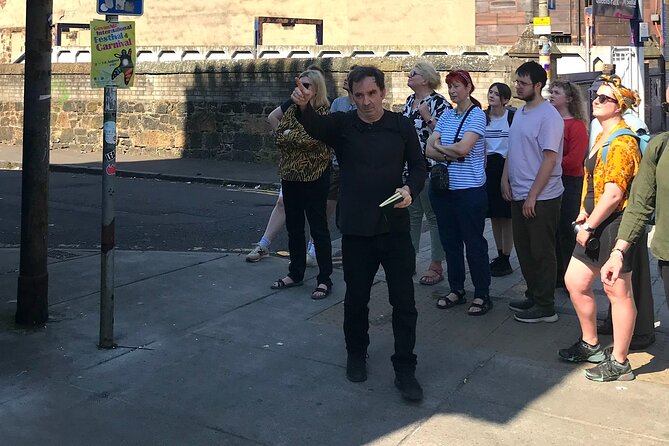
If you want a quick picture of Glasgow before picking neighborhoods for the rest of your trip, this tour fits the bill. The route starts in central George Square, then winds through Merchant City and finishes in the cathedral area. In about 2 hours 4 minutes to 2 hours 14 minutes of scheduled sightseeing, plus walking time that usually adds up to around 40 to 45 minutes, you cover a lot of ground.
The pacing works because many stops are look-and-learn moments rather than long museum-style stays. You get frequent chances to pause, listen, and orient yourself, then move on. That is a huge advantage in a city where a lot of the best architecture and street character is spread across different pockets.
One practical note: this tour does not bring you back to the exact spot where you started. It ends outside the Ramshorn Church on Ingram Street, which is handy if you want to keep exploring that side of the center right after.
More centuries read off the stonework:
- Glasgow: Pubs & History Walking Tour with Beer Tasting★ 5.0 · 81 reviews
- West of Scotland Cultural Tour★ 5.0 · 7 reviews
- Old Town Walking Tour History and Tales in Edinburgh★ 5.0 · 2,168 reviews
- Old Town Historical and Underground Tour★ 5.0 · 1,574 reviews
George Square Start: City Chambers, War Memorial, and the Pride Machine
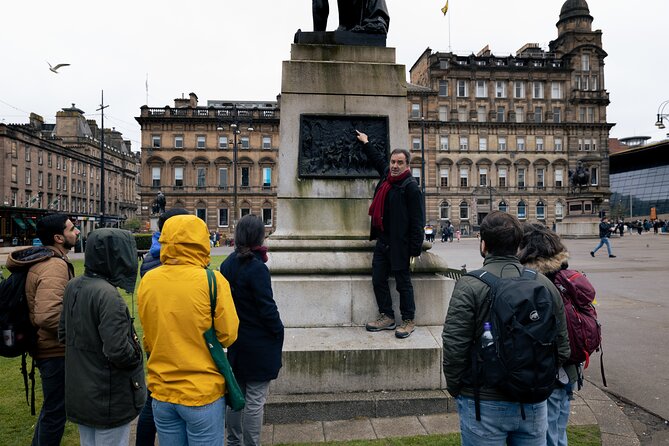
You begin at George Square, near George House, 50 George Square. The first major stop is Glasgow City Council’s headquarters, City Chambers. This is the kind of building you cannot ignore. The sculptures on the façade help explain how 19th-century Glaswegians pictured themselves, not as a small town, but as a serious civic power. If you like architectural symbolism, this is where the tour starts to feel more than just sightseeing.
From there, you move through a sequence of memorials and literary monuments that show how public space gets used to teach people what to value:
- The Glasgow War Memorial marks a turning point tied to World War I, with plenty of symbolism in the way the monument is set up.
- The Sir Walter Scott statue sits as George Square’s centerpiece-like stop, tied to Scott as a major influence on how Scotland gets imagined.
- The Robert Burns statue is where the story gets extra interesting: it is described as the first monument to Scotland’s national poet, and also as an early example of crowdfunding, with thousands showing up for the unveiling.
Even when you are not into statues, this trio helps you understand why Glasgow uses big public landmarks to mark identity.
Statue-Hop to Trade Power: Merchant’s House and the City’s Money Stories
After the George Square highlights, the route shifts toward what made the city wealthy and influential. You stop at the Merchant’s House, connected to the merchants behind Glasgow’s prosperity. The building is a window into how these people saw themselves, and why their decisions helped shape modern Glasgow.
Then comes the Gallery of Modern Art. It started life as a private mansion, so you can see how Glasgow’s wealth moved from private homes to public institutions over time. It also gives you a way to connect the tour’s “history walk” feel to Glasgow’s stronger modern identity as a cultural city.
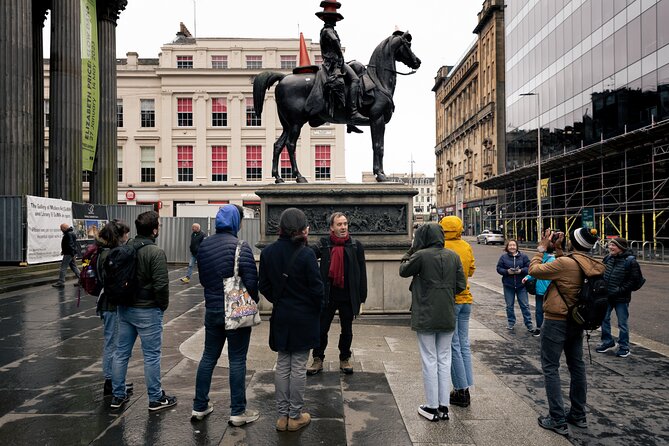
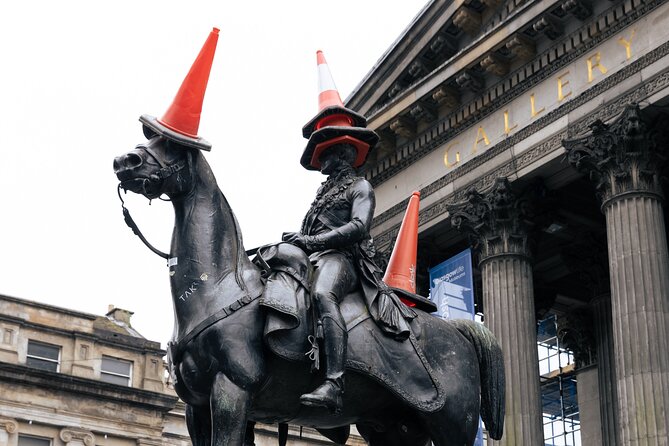
Next, you pass the Duke of Wellington statue. One reason it is unforgettable today is the traffic cone placed on the duke’s head. That small detail works like a gentle reality check: tradition in Glasgow often gets handled with humor, not just reverence.
And yes, you also get a stop at Paesano Pizza, a popular pizza place in Glasgow. The point here is not the slice alone. It is a reminder that modern city life sits right on top of older layers.
A Georgian Townhouse and the Busy Middle of the City
One segment of the walk focuses on an 18th-century Georgian townhouse in the heart of modern Glasgow. The tour frames it as a story about the original family that lived there, which adds texture to the city’s “big history” moments. You start noticing that the center is not only about monuments and institutions, but also about regular buildings where real people lived their day-to-day lives.
This is also where the tour leans into the “more scandalous side” idea. You are not left with a purely polished civic narrative. Instead, you start learning how trade, power, and social systems influenced everyday life and reputations.
If you like context more than trivia, you will probably enjoy how the walk keeps tying buildings to people and systems.
What Glasgow keeps behind the bar
- Guided Celtic Park Stadium Tour
★ 5.0 · 3,136 reviews - Tennent’s Brewery Tours Ticket
★ 5.0 · 1,938 reviews - City Sightseeing Glasgow Hop-On Hop-Off Bus Tour
★ 4.5 · 1,873 reviews - Oban, Glencoe, Highlands Lochs & Castles Small Group Day Tour from Glasgow
★ 5.0 · 1,432 reviews
Trades Hall, Candle Makers Street, and the Crafts That Built Glasgow
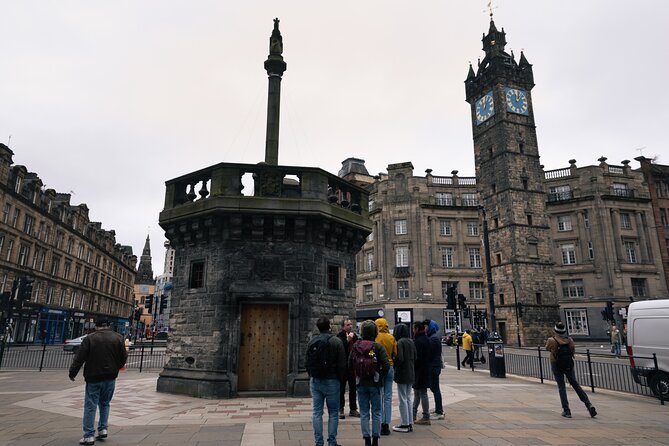
The route then visits Trades Hall of Glasgow. The Trades House represented working trades and looked after members who were too old to work. This is the kind of institution that tells you how a city cared for workers and also how organized trade helped Glasgow grow.
Nearby, you hear about an important street in medieval Glasgow where candle makers lived and worked. The idea was separation, specifically to reduce fire risk. Later, that same location became a market and warehouse zone. Now, it fits into Glasgow’s cultural district. It is a neat example of how “utility” streets evolve instead of disappearing.
These sections are especially valuable if you are the kind of traveler who likes to understand how a city functioned at street level, not just what famous visitors posed in front of.
Corinthian Club and the Way Buildings Keep Changing Jobs
You also stop at the Corinthian Club. The tour presents its building history as a series of roles: bank, courthouse, and county building, now used as a high-profile club and wedding venue. This is one of those stops that makes Glasgow feel more real. The city is not preserving old buildings by freezing them. It is reusing them, rebranding them, and keeping them central.
That “reused building” theme continues as you move through other institutional spaces. You end up with a strong sense of how Glasgow’s core has kept adapting without fully losing its identity.
Saints of Ingram and Hutchie’s Hospital Theme
A later stop highlights Saints of Ingram, paired with the older story of the Merchants House and the Trades House. The tour also references Hutchenson’s Hospital as one of the places associated with the three graces of Glasgow. Together, they looked after citizens of Glasgow over many years.
Even if you never remember all the names, you will likely remember the concept. You are being shown how civic responsibility was organized, not just preached. It is a practical kind of history that helps you read the city with more empathy.
From Old Fruitmarket to Trongate 103: Commercial Glasgow to Creative Glasgow
You reach City Halls and the Old Fruitmarket area. The Old Fruitmarket used to be part of Glasgow’s commercial engine, and the building still stands even though the function has shifted into retail use. The tour encourages you to imagine the old bustle in a space that now feels more everyday.
Then you step into Trongate, and specifically Trongate 103, described as an arts center with attractions like the Sharmanka Kinetic Gallery. This is where the tour’s modern side gets more visual. Instead of asking you to picture “culture happened here,” it gives you a direct present-day arts example.
This is a good time to check your energy level. You have been walking a while, but the stops keep refreshing your attention because the story changes from trade and governance to art and public creativity.
Britannia Panopticon Music Hall and the Stan Laurel Connection
Next is the Britannia Panopticon Music Hall, noted as the world’s oldest surviving music hall. The tour also points out that Stan Laurel, one half of the comedy double act, performed there as a young performer.
This is the moment I like most when a tour connects Glasgow to a wider world. Music halls were entertainment engines for working cities, and you get a sense of how Glasgow exported culture as well as imported influences.
If you enjoy comedy history or just like the idea that famous people started somewhere ordinary, this stop gives a satisfying payoff.
Mercat Cross, High Street Murals, and Religious Glasgow’s Symbols
The tour returns to medieval roots with Mercat Cross, a recreation of a medieval market cross where proclamations were made. This kind of stop is brief but meaningful. You start to grasp that public messages traveled differently in the past, often right in the middle of daily errands.
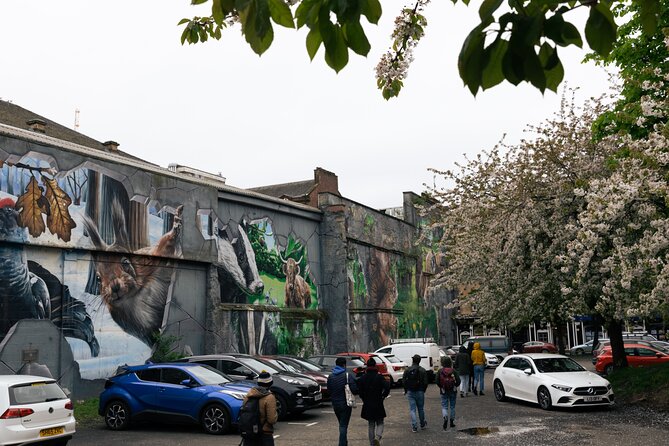
Then comes High Street, described as the heart of medieval Glasgow. You pass key attractions along the road, including murals tied to St Mungo, Glasgow’s patron saint. The tour also references the site of the old University, said to be the fourth oldest in Britain, plus several significant buildings.
If murals matter to you, do not rush this part. Even a quick look can help you understand how Glasgow tells stories on walls, not just on plaques.
Royal Infirmary Museum Area and Ramshorn Theatre
You also hit the David Livingstone statue area. The tour notes it originally stood in George Square, so you get a sense of how central objects get moved as the city changes.
Then you reach Ramshorn Theatre, opened in 1824 and replacing an earlier church on the site. Many notable Glaswegians are buried here. In more recent years it has served as a theatre and now is described as a language studies center linked to the University of Strathclyde.
This is a strong stop for travelers who like layered spaces. The building is not only a visual landmark. It also carries memory through its burial history and its modern use.
After that, you visit the Friends of Glasgow Royal Infirmary Museum. The tour frames it as the oldest hospital in Glasgow, tied to medical innovations. Even if you only spend a short moment here, it adds seriousness to the walk and broadens your view beyond monuments and politics.
Glasgow Cathedral to Provand’s Lordship: Ending in Oldest Glasgow Layers
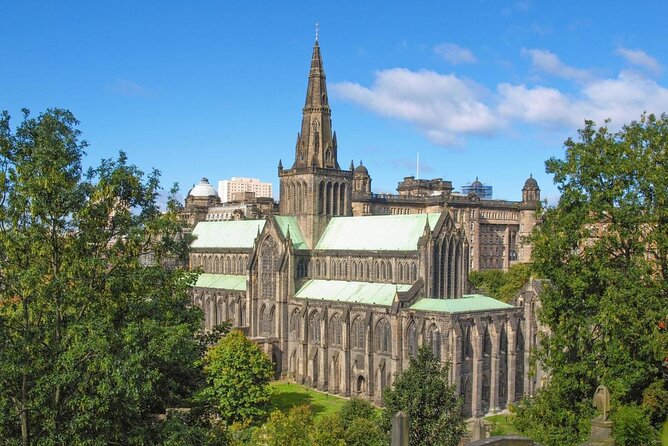
The tour finishes with an inside look at Glasgow Cathedral, dating to the 13th century, with a church on the site since the 6th century. You are closing the loop, from 19th-century identity markers and trade wealth to the deep time of religious Glasgow.
From there, you move to Provand’s Lordship, noted as one of the oldest buildings in Glasgow dating back to the 14th century. You get another physical reminder that this city’s “old parts” are not all ruins. Some of them still function as part of a living city.
Finally, you reach the St Mungo Museum of Religious Life and Art. The tour describes it as built to look much older than it is, and it celebrates different religions followed around the world. It is a good way to end, because it reframes “religion” from old stone into modern lived experience.
Price, Group Size, and Why $17.91 Feels Like Real Value
At $17.91 per person, this tour is one of those deals that makes sense even if you are only spending a day in Glasgow. Most of the stops are listed as free to visit, so your money goes into the guide, route planning, and explanation.
The group size is capped at 15 travelers, which matters in a city-center walking format. Smaller groups are easier for hearing and for getting the guide’s attention if you ask a question.
Also, the tour starts near public transportation and ends near other sights, which saves you time on your own navigation. A tour like this becomes especially worth it when you want to avoid spending your first day in Glasgow reading maps like homework.
What Can Go Wrong, and How to Prepare
Most of the time, this tour is straightforward. Still, I would plan for a couple of realities:
- Weather matters. The experience requires good weather. If it rains hard, the tour can be canceled and you might be offered another date or a full refund.
- Access can change. Some stops mention look-and-learn moments. If a building is temporarily closed for construction or private service, you might not be able to go inside as expected.
- It is a listening tour. You cover a lot of stops, and some visitors do not always catch every word if they are at the edge of the group. If you care about hearing the guide clearly, position yourself closer to the center.
If you enjoy architecture, statues, street murals, and stories about how a city grew, this tour is a strong fit. If you dislike walking or want long stays inside only a few places, you might prefer a slower format.
Who Should Book This Glasgow Tour?
Book it if you want a practical introduction to Glasgow in one afternoon. It is ideal for first-timers who want structure, couples or friends who enjoy chatting with a guide, and travelers who like to mix civic history with arts and street culture.
It is also useful if you plan to spend more time in the city center afterward. The ending area on Ingram Street is the right kind of place to keep going, and you will have the context to choose what you want to see next.
Should You Book It?
I think this is a strong choice if you value an efficient route and a guide who tells stories with clear explanations and humor. Guides such as Henry Bell and Bruce are repeatedly highlighted for communication, pacing, and the kind of city-love that makes landmarks feel connected.
If you have a tight schedule, this is a good first pass. If you hate walking, or you need big museum time inside fewer sites, you may want to pick a different format. Either way, do it on a day with good weather, and give yourself time after the tour to wander the ending neighborhood.
FAQ
How long is the Glasgow walking tour?
The tour runs about 2 hours 4 minutes to 2 hours 14 minutes, and walking time between attractions is around 40 to 45 minutes. The overall experience is described as approximately 2 hours and 45 minutes.
Where does the tour start and where does it end?
It starts at George House, 50 George Square, Glasgow G2 1EH. It ends outside the Ramshorn Church on Ingram Street, near 98 Ingram St, Glasgow G1 1EX.
What languages is the tour offered in?
The tour is offered in English.
Is the ticket mobile, and do I need any printout?
It uses a mobile ticket, so you do not need a printed ticket.
How big is the group?
The maximum group size is 15 travelers.
Do I need good weather for this tour?
Yes. The experience requires good weather. If it is canceled due to poor weather, you will be offered another date or a full refund.
The newest pours out of Glasgow





Historical Tours, compared.
Old Town Walking Tour History and Tales in Edinburgh
Read our review →
Multi-Sensory Small-Group Historic Vaults Tour in Edinburgh
Read our review →
Edinburgh Old Town: Historical Guided Walking Tour
Read our review →

Browse the lists this tour appears in